
A Comprehensive Comparison for Global Buyers
For steel buyers, specifiers, and procurement professionals, the choice between PPGI, GI, and PPGL steel coils can be confusing. Each product has distinct characteristics, performance profiles, and optimal applications. Selecting the wrong material can lead to premature failure, unnecessary costs, or lost market opportunities.
This guide provides a clear, data-driven comparison of these three coated steel products, helping you match the right material to your specific market requirements, environmental conditions, and end-use applications.
Explore our complete range of coated steel coils.
Quick Reference: What Do These Acronyms Mean?
| Product | Full Name | Core Characteristic |
|---|---|---|
| GI | Galvanized Steel | Zinc-coated steel, basic corrosion protection |
| PPGI | Pre-Painted Galvanized Iron | Zinc-coated steel + organic paint coating |
| PPGL | Pre-Painted Galvalume Steel | Aluminum-zinc coated steel + organic paint coating |
Key Distinction: The difference lies in both the metallic coating (zinc vs. aluminum-zinc) and the presence or absence of an organic paint layer.
The Fundamental Differences
GI Steel Coil (Galvanized Steel)
GI steel is produced by passing steel through a molten zinc bath, creating a metallurgically bonded zinc coating that provides sacrificial corrosion protection.
Composition:
Substrate: Cold rolled or hot rolled steel
Coating: Pure zinc (typically 99%+ Zn)
Coating mass: Z60 to Z275 (g/m²)
Appearance: Characteristic spangled or minimized spangle finish, silver-gray color.
View our GI steel coil specifications.
PPGI Steel Coil (Pre-Painted Galvanized Iron)
PPGI starts with a GI substrate, which then undergoes additional processing: cleaning, chemical treatment, primer application, and topcoat curing. The result is a composite material combining the corrosion protection of zinc with the aesthetic and protective properties of paint.
Composition:
Substrate: GI steel coil
Additional layers: Chemical conversion coating, primer, topcoat (and optional backcoat)
Paint systems: PE, SMP, HDP, PVDF
Appearance: Wide range of colors and finishes (glossy, matte, textured, metallic).
Explore our PPGI product range.
PPGL Steel Coil (Pre-Painted Galvalume Steel)
PPGL uses a Galvalume (GL) substrate—an aluminum-zinc alloy coating—instead of pure zinc. This substrate is then painted using the same coil coating process as PPGI.
Composition:
Substrate: GL steel (55% Al, 43.4% Zn, 1.6% Si)
Additional layers: Chemical treatment, primer, topcoat
Paint systems: PE, SMP, HDP, PVDF (often with modified formulations)
Appearance: Same color options as PPGI, with potentially different gloss characteristics due to substrate interaction.
View our PPGL / ZAM options.
Side-by-Side Comparison
1. Corrosion Resistance
| Product | Base Coating | Relative Corrosion Resistance* | Best Environment |
|---|---|---|---|
| GI | Pure zinc | Baseline (1x) | Interior, dry, rural |
| PPGI | Pure zinc + paint | 2-3x GI | Urban, industrial, moderate humidity |
| PPGL | Al-Zn alloy + paint | 4-6x GI | Coastal, marine, high humidity, industrial |
*Salt spray test performance (ASTM B117). Actual field performance varies by environment.
The Science:
GI: Zinc sacrifices itself to protect steel, forming zinc oxide/hydroxide
PPGI: Paint provides barrier protection; zinc provides sacrificial protection at scratches
PPGL: Aluminum forms stable oxide layer; magnesium (if present) enhances edge protection; paint adds barrier protection
2. Cut-Edge Protection
| Product | Edge Protection Mechanism | Performance |
|---|---|---|
| GI | Zinc sacrificial action | Good—zinc creeps to protect exposed edges |
| PPGI | Zinc sacrificial action | Good—same as GI at cut edges |
| PPGL | Aluminum oxide barrier + magnesium effect | Excellent—slower edge creep, self-healing properties |
3. Heat Resistance
| Product | Maximum Service Temperature | Performance at High Heat |
|---|---|---|
| GI | 200°C | Zinc begins to oxidize rapidly above 200°C |
| PPGI | 150-180°C | Paint may discolor or degrade above 150°C |
| PPGL | 300-350°C | Aluminum layer remains stable; paint limits apply |
4. Formability
| Product | Formability | Considerations |
|---|---|---|
| GI | Excellent | Zinc coating remains intact through severe forming |
| PPGI | Good to Excellent | Paint must be formulated for required bend radius |
| PPGL | Good | Al-Zn coating can be more brittle; requires proper grade selection |
5. Aesthetic Options
| Product | Color Range | Finish Options | Color Retention |
|---|---|---|---|
| GI | Limited (metallic only) | Spangled, minimized spangle, matte | N/A (unpainted) |
| PPGI | Unlimited (RAL, Pantone) | Glossy, matte, textured, metallic, embossed | Paint system dependent |
| PPGL | Unlimited (RAL, Pantone) | Same as PPGI | Paint system dependent; substrate may affect long-term appearance |
6. Cost Comparison
| Product | Relative Cost* | Value Proposition |
|---|---|---|
| GI | Baseline (1.0x) | Lowest initial cost, functional protection |
| PPGI | 1.3x – 1.6x GI | Aesthetics + protection, balanced cost |
| PPGL | 1.6x – 2.2x GI | Premium protection for demanding environments |
*Cost multiples are approximate and vary by specifications, market conditions, and order volume.
Market-by-Market Recommendations
Construction & Building Materials Market
| Application | Recommended Product | Rationale |
|---|---|---|
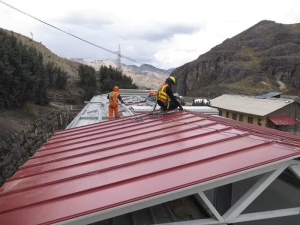
| Residential roofing (standard) | PPGI | Good balance of cost, aesthetics, and protection |
| Residential roofing (coastal) | PPGL | Superior corrosion resistance in salt environment |
| Commercial cladding | PPGI or PPGL | Aesthetic requirements + environmental fit |
| Industrial roofing | PPGI (SMP/HDP) | Durability and cost-effectiveness |
| Structural components (hidden) | GI | Functional protection, lowest cost |
| Prefabricated buildings | PPGI | Appearance + reasonable durability |
| Modular housing | PPGI | Color options, formability, cost balance |
Appliance & Manufacturing Market
| Application | Recommended Product | Rationale |
|---|---|---|
| Refrigerator panels | PPGI | Excellent surface finish, color matching |
| Washing machine cabinets | PPGI | Formability + appearance |
| HVAC housings | PPGI or GI | Corrosion resistance + cost |
| Electrical enclosures | GI or PPGI | Functional or aesthetic as required |
| Shelving and racks | GI | Cost-effective, functional |
Agricultural Market
| Application | Recommended Product | Rationale |
|---|---|---|
| Livestock buildings | PPGL or specialty | Resistance to ammonia and chemicals |
| Grain silos | PPGL | Superior corrosion resistance |
| Equipment sheds | PPGI | Cost-effective protection |
| Greenhouses | PPGI (special reflective) | Light reflection + corrosion resistance |
Infrastructure & Transportation
| Application | Recommended Product | Rationale |
|---|---|---|
| Highway sound barriers | PPGI or PPGL | Aesthetics + environmental exposure |
| Bridge components | PPGL or HD GI | Long-term durability |
| Signage structures | GI or PPGI | Function or appearance driven |
| Railway stations | PPGI or PPGL | Architectural requirements + durability |
Regional Market Considerations
Southeast Asia (Tropical, High Humidity)
Challenge: High humidity, heavy rainfall, temperature variations
Recommendation:
Coastal areas: PPGL with HDP or PVDF paint
Inland urban: PPGI with HDP paint
Budget projects: PPGI with SMP paint (with appropriate thickness)
Why: The combination of heat and humidity accelerates corrosion. PPGL’s aluminum content provides superior protection, while high-quality paint systems resist UV degradation.
Middle East (Desert, High UV, Temperature Extremes)
Challenge: Intense UV radiation, sand abrasion, high temperatures
Recommendation:
Premium projects: PPGL with PVDF paint (cool roof colors)
Standard commercial: PPGI with HDP paint, light colors
Interior applications: GI or standard PPGI
Why: UV resistance is critical. PVDF offers the best color retention. Light colors reduce heat absorption and thermal stress.
Africa (Diverse Climates)
Challenge: Varies from coastal humidity to desert aridity; infrastructure development
Recommendation:
Coastal West Africa: PPGL with HDP paint
East Africa highlands: PPGI with SMP or HDP
Southern Africa: Application-specific
Budget-conscious projects: GI with post-painting option
Why: Match product to specific microclimate. For remote projects, prioritize durability to minimize maintenance.
Europe (Moderate Climate, Stringent Standards)
Challenge: Building codes, environmental regulations, performance requirements
Recommendation:
Northern Europe: PPGI with HDP, appropriate for C3-C4 environments
Mediterranean coast: PPGL with PVDF for coastal areas
Urban commercial: PPGI with SMP or HDP
Industrial: PPGL for long-term durability
Why: European standards (EN 10169) require declared performance. Ensure products meet local certification requirements.
North America (Diverse Climates, ASTM Standards)
Challenge: Varying climate zones, building codes, warranty expectations
Recommendation:
Gulf Coast/Atlantic: PPGL with PVDF
Midwest/Continental: PPGI with HDP or SMP
Southwest/Desert: PPGI with PVDF (light colors)
Canada/Cold: PPGI with appropriate cold-temperature formability
Why: ASTM standards (A755, A792) provide clear specifications. Warranty expectations often drive material selection.
South America (Varied Climates, Developing Markets)
Challenge: Economic considerations, climate diversity
Recommendation:
Coastal Brazil: PPGL with HDP
Andean regions: PPGI with SMP
Interior/rural: GI or standard PPGI based on budget
Industrial zones: PPGL for chemical resistance
Why: Balance cost and performance based on project economics and local conditions.
Decision Matrix: Finding Your Optimal Product
Use this matrix to guide your selection:
| If you prioritize… | And your market is… | Your best choice is… |
|---|---|---|
| Lowest initial cost | Interior/dry applications | GI |
| Lowest initial cost | Exterior/moderate climate | PPGI (PE paint) |
| Aesthetics + reasonable cost | Urban/commercial | PPGI (SMP/HDP paint) |
| Maximum durability | Coastal/industrial | PPGL (HDP/PVDF paint) |
| Long warranty period | Any demanding environment | PPGL with premium paint |
| Fast delivery | Standard requirements | GI or PPGI (stock items) |
| Custom colors | Architectural projects | PPGI or PPGL |
| High formability | Complex profiles | PPGI (with appropriate paint flexibility) |
Lifecycle Cost Analysis
While initial cost is important, total lifecycle cost often tells a different story.
20-Year Lifecycle Cost Comparison (Example)
| Scenario | Product | Initial Cost | Maintenance | Replacement Risk | 20-Year Total Cost |
|---|---|---|---|---|---|
| Coastal commercial building | GI | Low | High (painting every 5-7 years) | Moderate | High |
| Same building | PPGI (SMP) | Medium | Low (occasional cleaning) | Low | Medium |
| Same building | PPGL (HDP) | Medium-High | Minimal | Very Low | Medium-Low |
| Same building | PPGL (PVDF) | High | Minimal | Negligible | Low-Medium |
Conclusion: For demanding environments, investing in PPGL with appropriate paint systems often yields the lowest total cost over the building’s life.
Quality Indicators: What to Look For
For GI Steel Coil
Coating mass: Verify specified Z number (e.g., Z180 means 180 g/m²)
Spangle control: Minimized spangle for smoother painting surface
Passivation: Chromate or chrome-free treatment for storage protection
Flatness: Ensure符合flatness standards for your application
For PPGI Steel Coil
Paint system: Confirm PE, SMP, HDP, or PVDF as specified
Coating thickness: Minimum 20 μm topcoat, 5-7 μm primer
Back coating: Present for corrosion protection
Reverse side marking: Indicates manufacturer and specifications
T-bend test: Verify adhesion meets requirements (0T-4T)
For PPGL Steel Coil
Substrate coating mass: Verify AZ number (e.g., AZ150)
Paint compatibility: Confirm paint system formulated for GL substrate
Edge protection: Enhanced formulations for cut-edge corrosion resistance
Salt spray performance: Request test data for your environment
Common Misconceptions
| Misconception | Reality |
|---|---|
| “PPGI and PPGL are the same” | Different substrates (GI vs. GL) with different corrosion performance |
| “Thicker paint always means better quality” | Paint system chemistry matters more than thickness alone |
| “GI doesn’t rust” | GI corrodes (white rust) and eventually red rust; it’s sacrificial protection |
| “PPGL is always the best choice” | PPGL is optimal for demanding environments but may be over-specified for mild conditions |
| “All paint systems perform equally” | PVDF outperforms PE significantly in UV resistance and color retention |
| “Cheaper is better for budget projects” | Premature failure can cost more than initial savings |
Making Your Final Decision: A Step-by-Step Approach
Step 1: Define Your Requirements
End-use application
Environmental conditions (C1-CX classification)
Aesthetic expectations
Expected service life
Budget constraints
Local standards and codes
Step 2: Evaluate Product Options
GI: Suitable for your environment?
PPGI: Paint system appropriate for exposure?
PPGL: Justified by conditions or requirements?
Step 3: Compare Specifications
Substrate thickness and grade
Metallic coating mass
Paint system and thickness
Formability requirements
Warranty offerings
Step 4: Consider Supply Chain
Lead time requirements
Minimum order quantities
Packaging for transit
Documentation needs (MTC, CO, etc.)
Step 5: Calculate Total Cost
Initial material cost
Fabrication costs
Installation costs
Expected maintenance
Replacement frequency
20-year total cost comparison
Step 6: Verify Supplier Capability
Quality certifications (ISO, etc.)
Production capacity
Technical support availability
References and track record
After-sales service
Why Baosteel company for Your Coated Steel Needs
Comprehensive Product Range
We manufacture all three products—GI, PPGI, and PPGL—allowing objective recommendations based on your needs, not product availability.
Technical Expertise
Our metallurgists and coating engineers understand how each product performs in different environments and applications.
Quality Consistency
ISO 9001 certified production ensures consistent quality across all batches and products.
Customization Capability
From specific paint systems to custom colors, we tailor products to your exact requirements.
Global Experience
We supply to over 30 countries across diverse climates and market conditions, accumulating extensive application knowledge.
Contact Baosteel company’s Technical Team for personalized product recommendations based on your market and application.
Summary: Which One Is Better for Your Market?
| Market Characteristic | Recommended Product |
|---|---|
| Interior applications, dry climate | GI (most economical) |
| Exterior, moderate climate, standard aesthetics | PPGI with SMP paint |
| Exterior, demanding climate, premium appearance | PPGI with HDP or PVDF paint |
| Coastal, marine, high humidity | PPGL with HDP or PVDF paint |
| Industrial, chemical exposure | PPGL with specialty coatings |
| Agricultural, livestock | PPGL with anti-microbial coatings |
| Hot climate, high UV | PPGL or PPGI with PVDF, light colors |
| Cold climate, freeze-thaw | PPGI with appropriate flexibility |
| Budget-constrained, short-term | GI (with post-painting option) |
| Long-term investment, low maintenance | PPGL with premium paint |
Need Expert Guidance?
Choosing between PPGI, GI, and PPGL doesn’t have to be complicated. Our technical sales team is ready to:
Review your project requirements
Assess your local environmental conditions
Recommend the optimal product specification
Provide samples for testing and evaluation
Quote competitive pricing for your order volume
Contact Baosteel company Today for expert assistance in selecting the right coated steel coil for your market.
Explore our complete range of coated steel products.
Baosteel company: The Right Coated Steel for Every Market